The art of choosing in Google Ads: why Performance Max is not always the answer (and the strength of Shopping campaigns)
Performance Max is not always the right call in fashion. Two real accounts show that Shopping + Demand Gen (and brand protection where needed) often beat full automation: more feed control, clearer intent, readable ROAS. PMax still helps when it is ring-fenced (e.g. womenswear categories), not when it runs the whole account alone.
Two real accounts in fashion ecommerce. Same goals, different structures. Here is why Shopping campaigns and Demand Gen often build a more solid result than a single Performance Max.
A clear look at digital marketing (no magic)
When we talk about artificial intelligence in online advertising, it is easy to picture a machine that never gets it wrong. In Google Ads that machine is called Performance Max (or PMax): one tool that can cover Search, Display, YouTube, Gmail and Shopping listings.
The question is simpler, closer to everyday life: do you walk into a store knowing what you need, or do you only window-shop? Is one big automation really the ideal setup for every online clothing brand?
Looking at the numbers and at how people buy online, the answer is: not always.
We will walk through two real fashion accounts to show why, in many cases, a structure led by Shopping campaigns, supported by Demand Gen and targeted brand awareness, remains one of the most durable paths.
- 1. Intent capture — Shopping: shows the exact product at the moment of need (high purchase intent).
- 2. Stimulus and brand awareness — Demand Gen: images and video on YouTube, Discover and Display to build desire over time.
First case: balance in a mature account
Picture a boutique on a busy street. Some people walk in knowing what they want; others are drawn by the window. In the first fashion account that dynamic shows up in clear numbers.
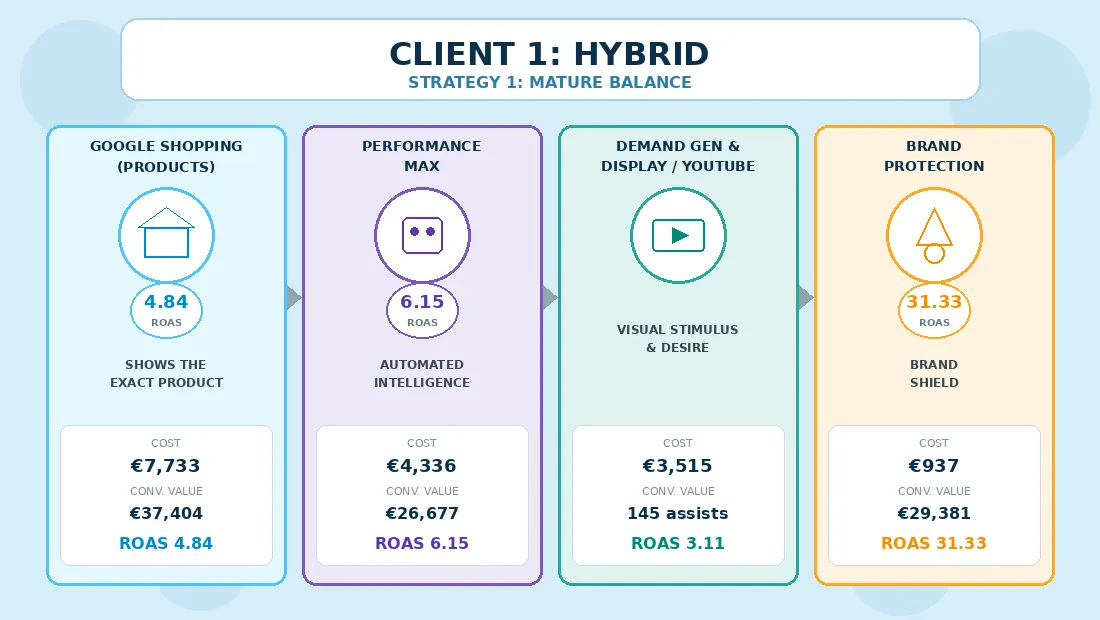
| Campaign type | Cost (€) | Conv. value | ROAS |
|---|---|---|---|
| Shopping (promo products) | 7,733.55 | 37,404.67 | 4.84 |
| Performance Max (womenswear) | 4,336.67 | 26,677.65 | 6.15 |
| Demand Gen (trends & visual) | 3,515.65 | 10,920.78 | 3.11 |
| Shopping (high-ROAS segment) | 3,461.49 | 16,086.60 | 4.65 |
| Brand protection (exact Search) | 937.66 | 29,381.19 | 31.33 |
Why Shopping still pulls hard
The Shopping campaign on promo products spends about €7,700 and returns over €37,400 in value — ROAS 4.84: almost five euros back for every euro spent. Why? Shopping is the clear storefront sign: product photo, price and brand while someone is looking for that item.
The complementary role of Performance Max
This account also runs Performance Max on womenswear categories, with a strong ROAS (6.15). It does not own the account alone: it is ring-fenced inside a balanced system, not “one button for everything”.
Visual stimulus with Demand Gen
Demand Gen (trends and visual content) costs about €3,500 and returns over €10,900 (ROAS 3.11). In fashion, purchase is often emotional: Demand Gen on YouTube, Discover and Gmail plants a desire, like flipping through a magazine on a coffee break.
The final harvest: brand protection
Brand protection on exact-match Search spends under €1,000 and returns nearly €29,400 — ROAS 31.33. People who land here already know the brand (Demand Gen, Shopping, word of mouth) and come back to close the buy.
Second case: focused strategy, no PMax
The second fashion account is even leaner. No Performance Max in flight.
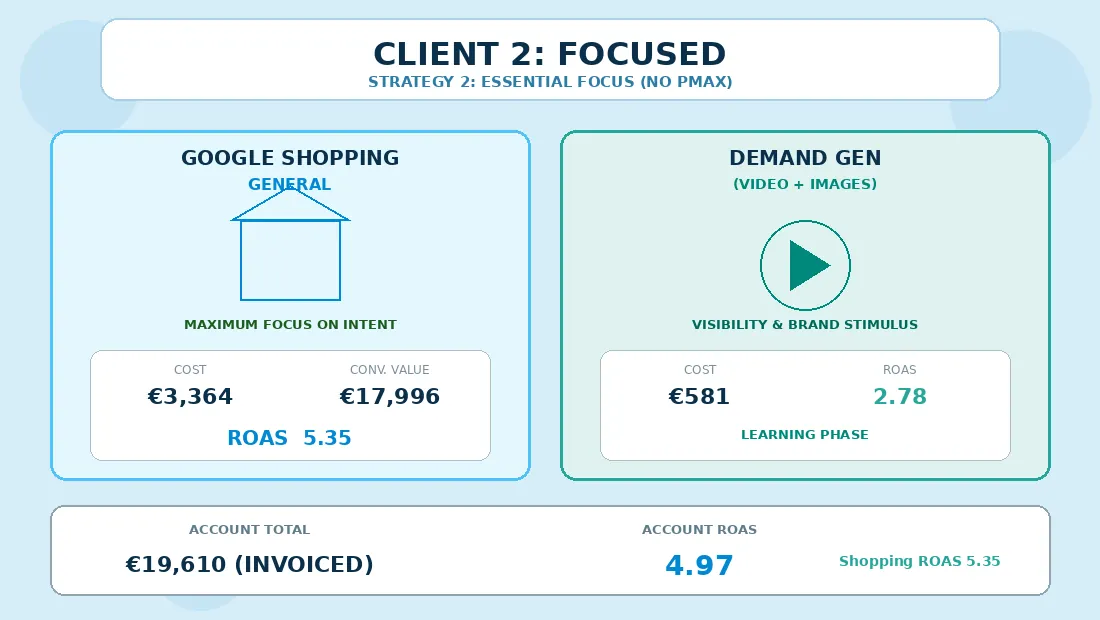
| Campaign type | Cost (€) | Conv. value | ROAS |
|---|---|---|---|
| Shopping | 3,364.00 | 17,996.58 | 5.35 |
| Demand Gen (image + video) | 581.33 | 1,613.55 | 2.78 |
| Account total | 3,945.69 | 19,610.13 | 4.97 |
Shopping takes most of the budget (about €200/day). In 30 days it returns almost €18,000 in value against about €3,360 spend: ROAS 5.35. Alongside, Demand Gen in learning (ROAS 2.78) feeds the pool of people who later buy on Shopping.
Comparing the two fashion accounts
| Metric | Hybrid account | Focused account |
|---|---|---|
| Strategy | Shopping + PMax + Demand Gen + brand | Shopping + Demand Gen (no PMax) |
| Shopping performance | ROAS 4.84 on ~€7.7k | ROAS 5.35 on ~€3.3k |
| Demand Gen role | Trend stimulus (ROAS 3.11) | Interest generation (ROAS 2.78, learning) |
| Overall result | Brand protection at ROAS 31.33 | Account ROAS ~4.97 |
The fishing metaphor: why PMax sometimes fails in fashion
- Performance Max is an automatic trawl net: it catches everything, including weak placements.
- Shopping is line fishing: it shows the exact product to someone already searching.
- Demand Gen (YouTube and visual) is the bait: it builds desire and brand awareness over time.
Practical playbook for fashion ecommerce
1. Do not hand everything to full automation on day one
In competitive fashion markets, PMax can cannibalise brand search. Keeping Shopping campaigns split (for example menswear/womenswear or by margin) gives you control over the product feed.
2. Build a multi-channel funnel
- Upper funnel — Demand Gen on YouTube and Discover
- Middle funnel — Shopping
- Lower funnel — brand protection on Search
3. Prefer transparent metrics
Shopping campaigns return impression share (budget / rank). On PMax that transparency is often thinner.
Conclusion: automation yes — pilot always on
Both case studies show that leaning on Shopping campaigns, backed by Demand Gen and YouTube for brand awareness, remains a solid strategy for fashion ecommerce.
Frequently asked questions
Is Performance Max always better than Shopping campaigns?
No. In fashion ecommerce, Shopping + Demand Gen + brand protection often give more control and a more stable ROAS.
What is Demand Gen for in fashion?
To build desire and brand awareness on YouTube, Discover and Gmail.
When does Performance Max make sense?
With a large catalogue, reliable conversions and clear boundaries (e.g. specific menswear or womenswear categories) — not as the only catch-all campaign.
What is brand protection?
Exact-match Search campaigns on the brand name: low cost, often very high ROAS.
How do I read impression share on Shopping?
Search lost IS (budget) and (rank) show whether you lose impressions due to budget or ranking.
Want to know if PMax is helping or muddying your fashion account?
Request a free audit